Reality Manuscript › Articles › Spiritual Foundations
Manifestation Statistics: What the Research Actually Shows
Manifestation statistics with sources: how many people believe, what the Dixon study and Pew surveys found, and what the numbers do not prove.
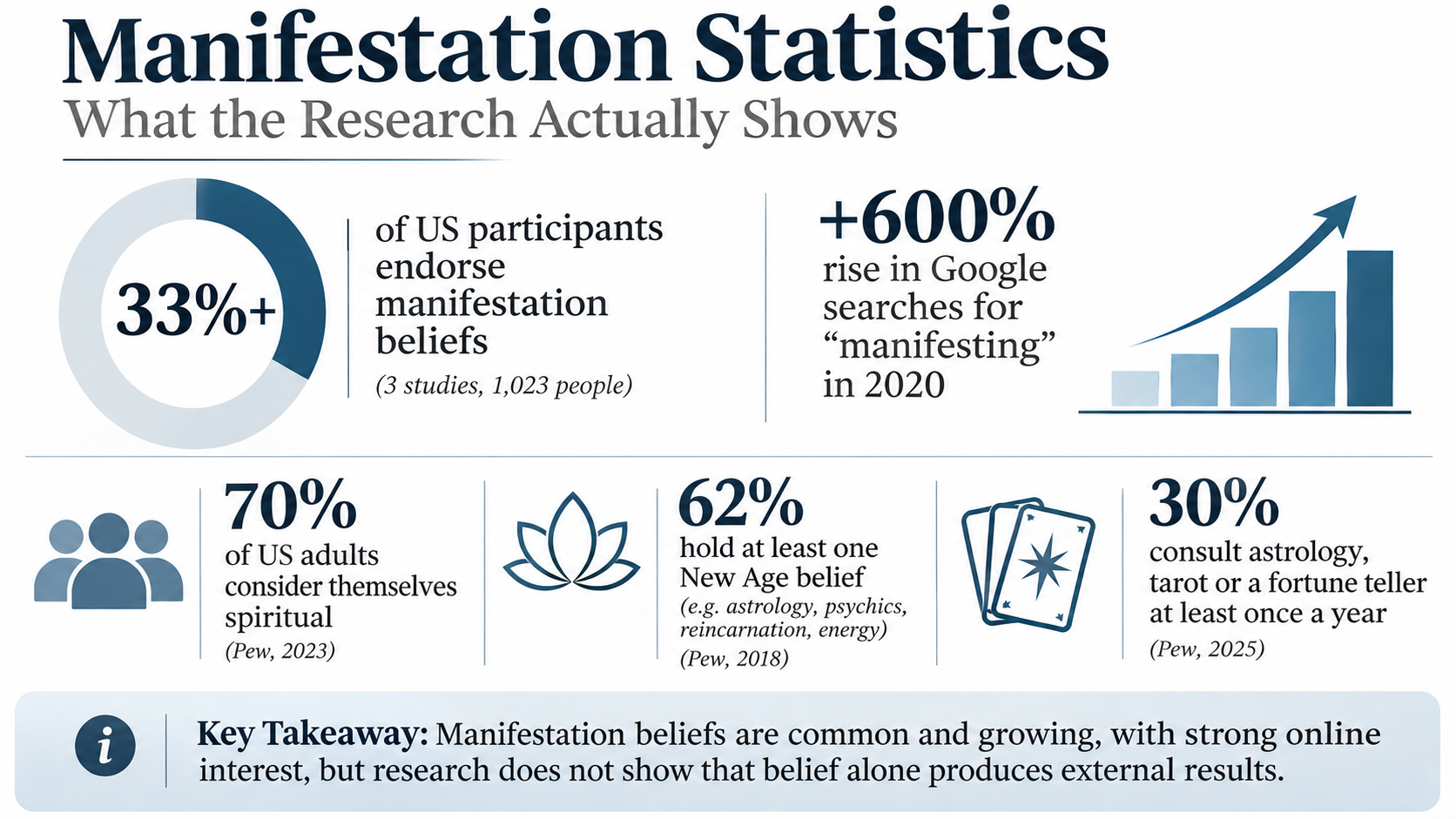
Research suggests more than one-third of US adults endorse manifestation beliefs. Those beliefs are linked with higher optimism and ambition, but also with risky investing and unrealistic expectations. Surveys measure belief, not results: no study yet shows manifestation alone produces external outcomes.
This page collects the most useful published figures on manifestation and the wider spiritual landscape it sits in, with what each number does and does not mean. Writers, students and researchers are welcome to cite it.
Key figures at a glance
| Finding | Figure | Source |
|---|---|---|
| US participants endorsing manifestation beliefs | More than one-third (3 studies, 1,023 people) | Dixon, Hornsey and Hartley |
| Rise in Google searches for "manifesting", 2020 | About 600% | Balzer, Religion Compass (2025) |
| Cumulative TikTok views for #manifestation, mid-2024 | 62.8 billion | Balzer (2025), citing a third-party tracker |
| US adults who consider themselves spiritual | 70% | Pew Research Center (2023) |
| US adults holding at least one New Age belief | 62% | Pew Research Center (2018) |
| US adults consulting astrology, tarot or a fortune teller yearly | 30% | Pew Research Center (2025) |
How many people believe in manifestation?
The most direct measurement comes from Matthew Dixon, Matthew Hornsey and Nicole Hartley. Their work was published online in July 2023 and appeared in Personality and Social Psychology Bulletin. Across three studies with 1,023 US participants, more than one-third endorsed manifestation beliefs.
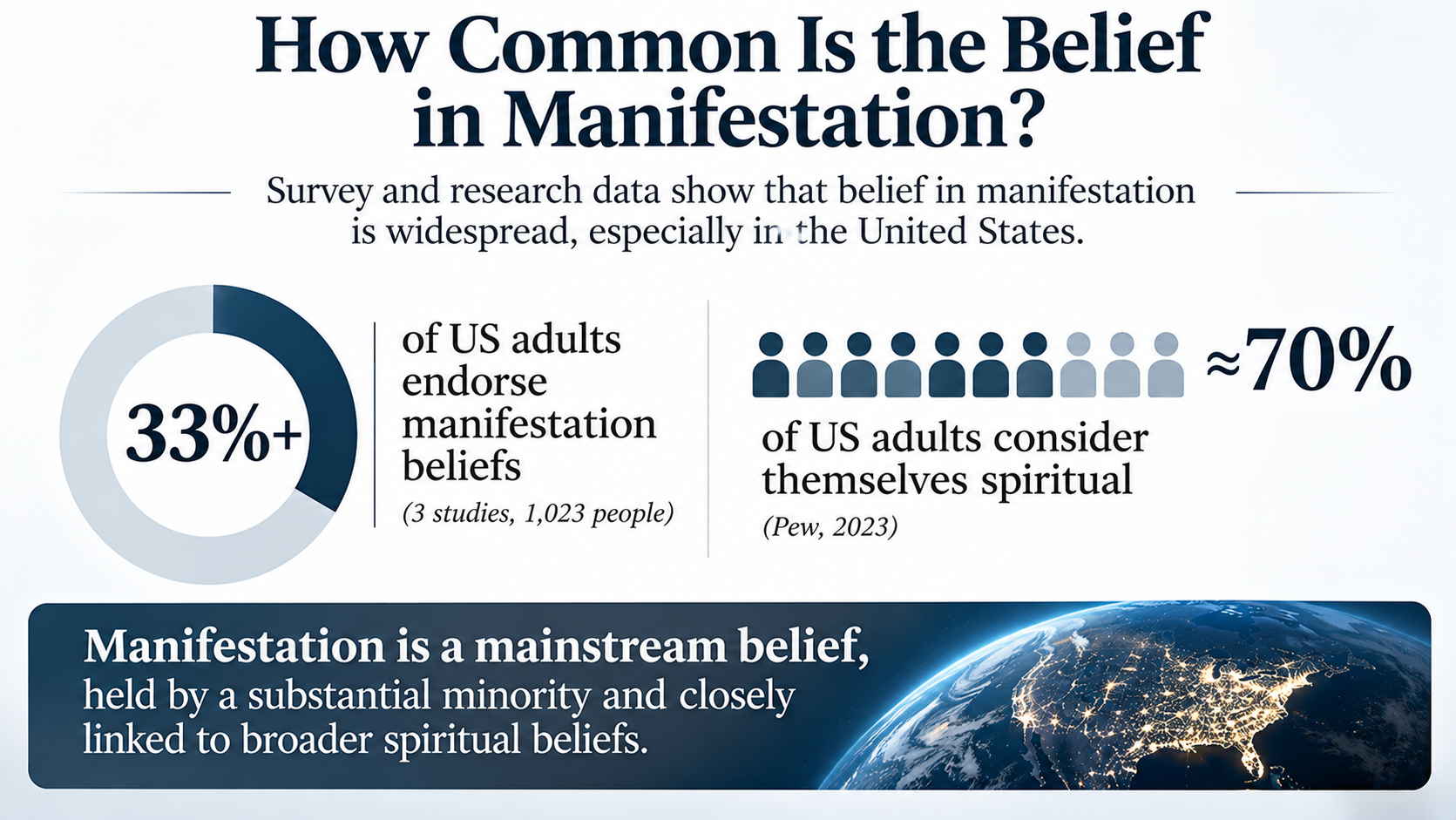
That does not mean a third of Americans practise manifestation every day, or accept every Law of Attraction claim. The researchers measured agreement with specific statements using an 11-item Manifestation Scale. Manifestation means different things to different people: for one, it is visualising a goal and acting on it; for another, it is the belief that the universe responds directly to thought.
Source: Dixon, Hornsey and Hartley, manifestation beliefs study
What researchers mean by manifestation
The study found two broad dimensions of belief:
- Personal power: thoughts, visualisation, self-talk and acting as if a result is possible help bring it about.
- Cosmic collaboration: the universe, a higher power or a spiritual force takes part in delivering the result.
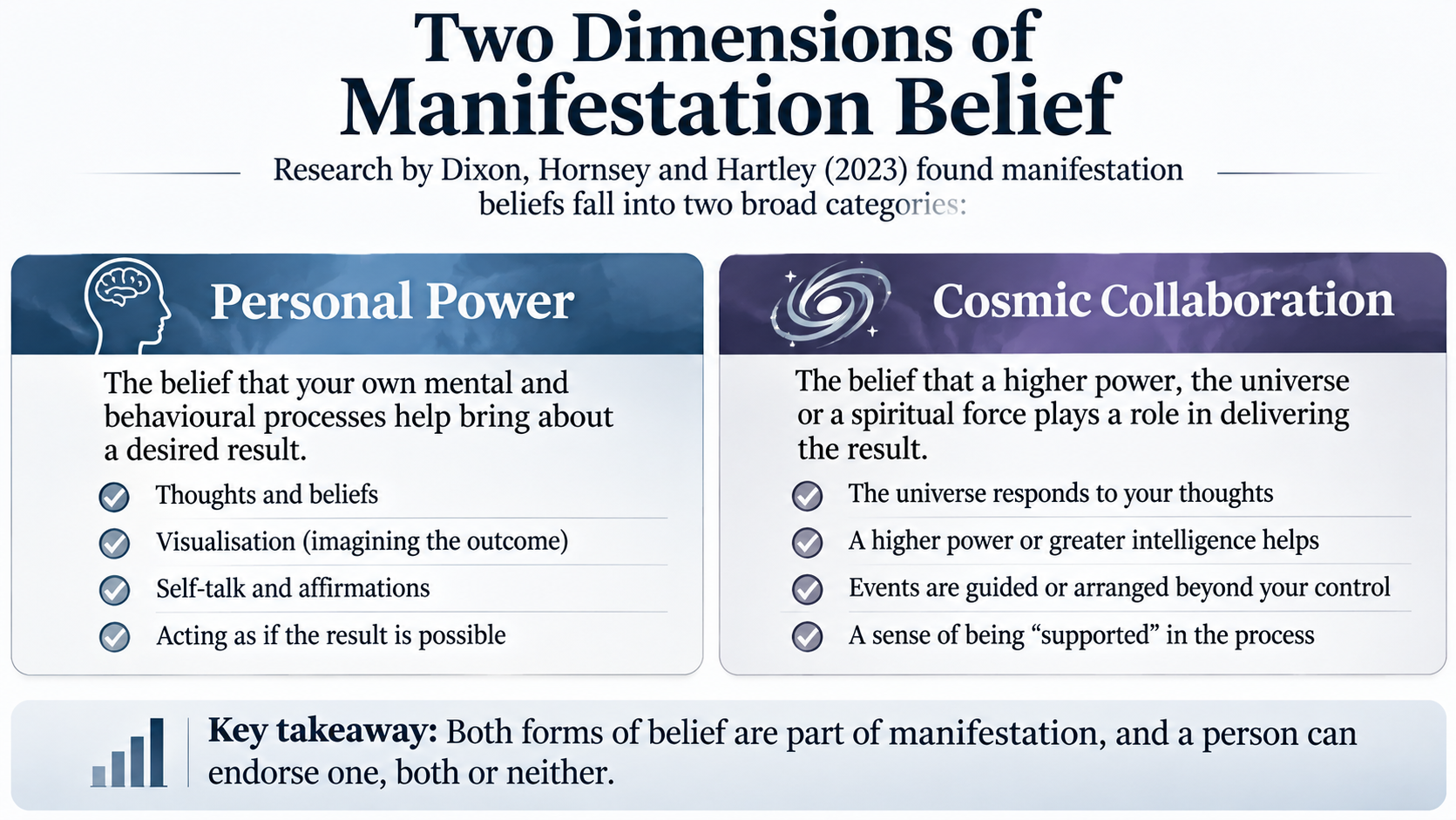
Someone can rehearse a job interview in imagination without believing the universe arranges the meeting. Someone else may see the interview as part of a larger process. Treating both as one belief hides what the research measures. Visualisation can plausibly change behaviour by clarifying a goal or sustaining motivation. The claim that thoughts directly cause outside events needs a different kind of evidence, and the scale itself does not supply it.
Does believing in manifestation make people more successful?
Stronger manifestation beliefs were associated with greater perceived success, higher aspirations and more optimistic expectations. An association cannot show direction, though: belief may raise confidence, confident people may be drawn to belief, or a third factor may drive both.
Expecting success, feeling successful and achieving success are three different things. A questionnaire about beliefs cannot separate them.
The same research found less reassuring links: attraction to risky investments, reported bankruptcy and expectations of unusually fast success. That does not mean manifestation causes financial trouble. It does mean confidence helps when it prompts action and becomes risky when it replaces evidence.
What the evidence does not establish: that visualisation, affirmations or belief in the universe can independently guarantee prosperity, relationships or any other external outcome.
The rise of manifestation online
In a 2025 paper in Religion Compass, Kristen M. Balzer traced the growth of modern manifestation culture. She reports Google searches for "manifesting" rose by about 600% in 2020 and stayed elevated, and cites 62.8 billion cumulative TikTok views for #manifestation by mid-2024.
- The Google figure measures search interest, not a 600% rise in believers. Curiosity, news and sceptics all search too.
- The TikTok figure is a cumulative view count from the third-party tracker TikTokHashtags.com. It includes repeat views and casual browsing; it is not a count of people.
Both show attention and visibility, not effectiveness or belief.
Source: Balzer, Religion Compass (2025)
The wider spiritual audience
A 2023 Pew Research Center survey of 11,201 US adults gives the context manifestation grows in.
| Finding | Share of US adults |
|---|---|
| Consider themselves spiritual in some way | 70% |
| Spiritual but not religious | 22% |
| Both religious and spiritual | 48% |
| Religious but not spiritual | 10% |
| Neither religious nor spiritual | 21% |
| Believe people have a soul or spirit beyond the body | 83% |
| Believe there is something spiritual beyond the natural world | 81% |
| Believe there are things science cannot explain | 74% |
| Have felt a sudden connection with something beyond this world | 45% |
Survey conducted 31 July to 6 August 2023. Figures may not total 100% because of rounding.
These are not manifestation statistics. Believing in a soul does not mean believing thoughts attract events. The overlap is cultural: manifestation draws on ideas that already have a large audience, such as personal agency, spiritual possibility and the hope that life can change.
Source: Pew Research Center, Spirituality Among Americans
How widespread are New Age beliefs?
A 2018 Pew survey found 62% of US adults held at least one of four New Age beliefs: spiritual energy in physical objects, psychics, reincarnation, or astrology. That is not 62% identifying as New Age; it counts anyone holding just one belief. Adding these categories together into one headline figure about manifestation would exaggerate the evidence.
Source: Pew Research Center, New Age beliefs (2018)
Astrology, tarot and other practices
Pew's report of 21 May 2025, based on 9,593 US adults surveyed in October 2024, found 30% consult astrology, tarot cards or a fortune teller at least once a year.
| Practice | Share who consult yearly |
|---|---|
| Astrology | 28% |
| Tarot cards | About 11% |
| Fortune tellers | 6% |
| At least one of the three | 30% |
The categories overlap, so do not add them. About 20% of adults used them mostly for fun and around 10% mostly for insight. Participation is not the same as conviction, and the same is true of anyone watching an affirmation video.
Belief that stars and planets influence lives barely moved: 27% in 2024 against 29% in 2017. Online attention can surge without a matching change in belief.
Source: Pew Research Center, 3 in 10 Americans consult astrology, tarot cards or fortune tellers
What these statistics tell us
- Manifestation beliefs are measurable and common. More than a third of participants in the Dixon studies endorsed them. This is not a tiny fringe.
- Manifestation has a large digital presence. Searches and views show attention, not how many people practise or how firmly they believe.
- Popularity and effectiveness are separate questions. Proving external results requires evidence that separates manifestation from motivation, planning, opportunity and chance.
This matters most where prosperity is involved. Setting goals, rehearsing hard conversations and noticing opportunities is different from promising the universe will deliver wealth if you hold the right state of mind. The New Thought teachers this site studies, from Thomas Troward to Neville Goddard, always paired inner conviction with disciplined daily practice. See the history in the New Thought movement.
How to cite this page
Reality Manuscript. "Manifestation Statistics: What the Research Actually Shows." realitymanuscript.com/article/manifestation-statistics. Please cite the original studies linked above for specific figures.
Products / Tools / Resources
Academic and survey sources
- Dixon, Hornsey and Hartley: manifestation beliefs and outcomes
- Balzer: manifestation culture, Religion Compass
- Pew Research Center: Spirituality Among Americans (2023)
- Pew Research Center: astrology, tarot and fortune tellers (2025)
- Google Trends: relative search interest, not absolute counts.
Historical texts on this site
- The New Thought movement: from Quimby to Neville.
- Thomas Troward: the mental science lectures in context.
- The Master Key System: Haanel's complete 24-part course.
A record of your own practice
The honest way to test a practice is to write it down: the outcome you want, what you did, what happened and what was outside your control. Click here to view The Manifestation Journal, built for exactly that kind of daily record. Prefer to start free? Try the 369 workbook or the Imaginal Scene Builder.