Reality Manuscript › Articles › Spiritual Foundations
Rosicrucian Manifestation: The 400-Year Protocol
Explore Rosicrucian manifestation through 400 years of mental training, from Fludd and Heindel to visualization, retrospection and modern revision.
Rosicrucian manifestation begins with a different question: what are you doing with your mind right now?
The first printed edition of the Fama Fraternitatis appeared in 1614. Almost three centuries later, Max Heindel set out specific exercises for concentration, meditation, contemplation and retrospection. Later still, Neville Goddard built a modern manifestation system around imagination, assumption and revision.
Put these sources side by side and a pattern appears. The vocabulary changes. The theology changes. The practices change. But the core question stays the same: how can a person deliberately train the inner life?
What Do Rosicrucians Believe About the Mind?
The early Rosicrucian tradition did not begin as a manifestation manual. The Fama Fraternitatis presented a broad programme involving humanity, nature, knowledge and divine order, and described the human being as a microcosm within the larger order of creation.
That idea matters because it made the human interior meaningful territory. The mind was not background noise; it belonged inside the spiritual investigation. Later Rosicrucian teachers made that investigation practical through concentration, meditation, contemplation and retrospection.
1614: the microcosm and the inner architecture
The Fama discussed theology, physics, mathematics, medicine and nature. Its larger project was reform and deeper knowledge, not wish fulfilment. But the microcosm idea created an inner–outer framework:
- The individual as mirror: a person is understood within the larger structure of nature and creation.
- The method: study the human being to understand the larger order.
This is not yet the modern law of attraction, nor the law of assumption. It is the intellectual foundation that later traditions built on when they placed consciousness and imagination at the centre.
Robert Fludd, Consciousness and Rosicrucian Visualization
Robert Fludd (1574–1637), the English physician who publicly defended the Rosicrucians, turned the microcosm idea into an extraordinary visual system. His Utriusque Cosmi Historia (1617–1618) mapped the macrocosm and microcosm through cosmology, mathematics, music, optics and astrology.
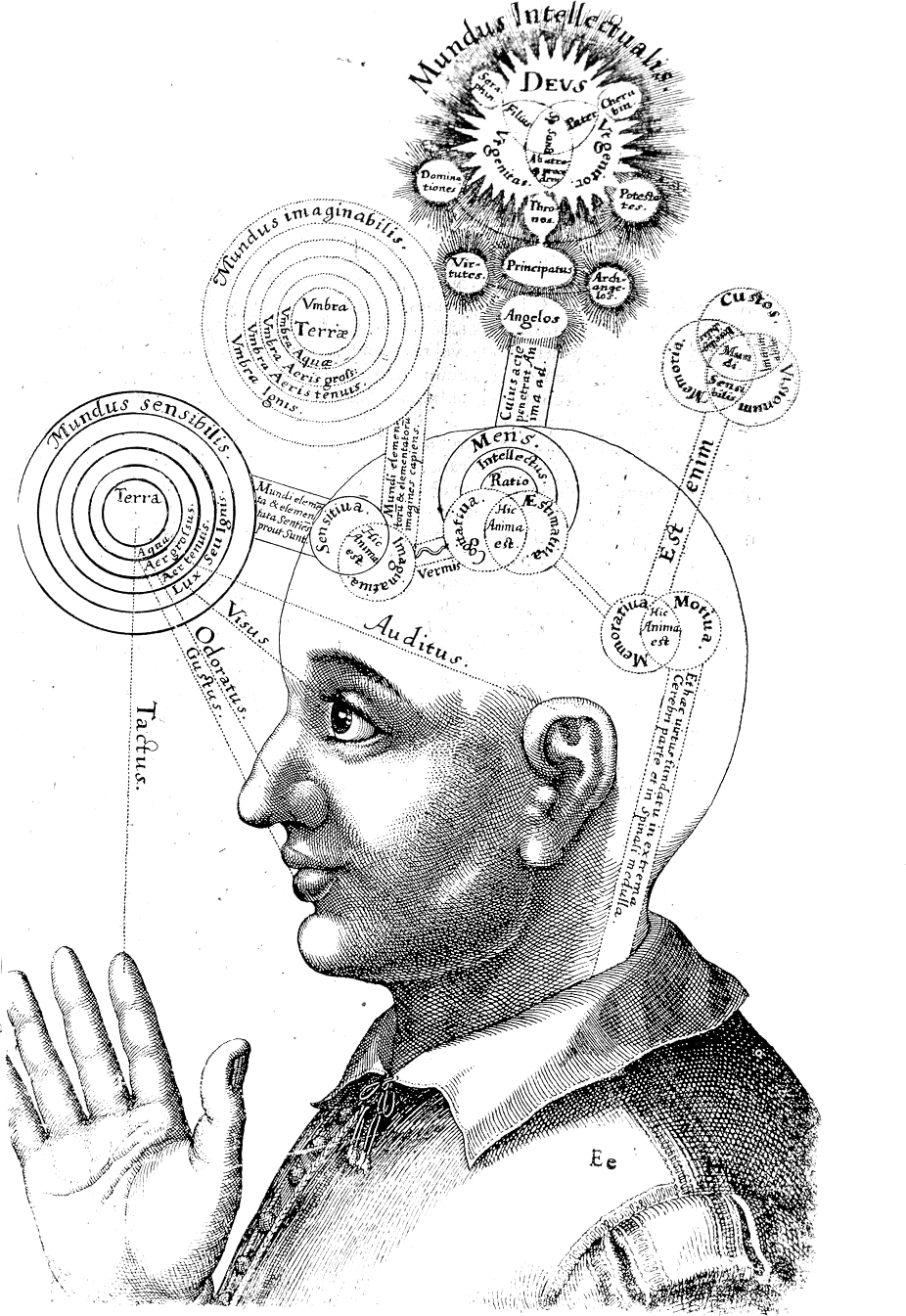
Fludd's plates of consciousness place imagination as a distinct faculty between the senses and the higher mind. The inner world is drawn as something with structure, something that can be mapped and worked with. This is the direct historical archive behind Rosicrucian visualization: imagination treated as an organ of perception, not idle fantasy.
Rosicrucian Exercises: From Philosophy to Practice
The later tradition supplies what the manifestos do not: explicit mental exercises. In The Rosicrucian Cosmo-Conception (1909), Max Heindel describes four of them.
| Exercise | What the practitioner does | Modern parallel |
|---|---|---|
| Concentration | Focuses on one object and builds a clear mental image | Sustained visualization, SATS |
| Meditation | Investigates the object's history and relationships | Sensory, associative visualization |
| Contemplation | Holds the object before inner vision, quietly alert | Sustained imaginal attention |
| Retrospection | Reviews the day backward, evening to morning | Revision |
Concentration: train attention first
Modern visualization usually starts with the desired outcome. Heindel starts with attention:
- Pick an ordinary object.
- Hold it in your mind.
- Study its form.
- Bring your attention back the moment it wanders.
The object is almost secondary. The real exercise is learning to direct consciousness. Without trained attention, visualization slides into daydreaming.
Rosicrucian meditation: investigate the image
Next, the practitioner explores the object through sustained thought. Where did it come from? What materials made it? Who made it? What forces shaped it? The object becomes a doorway into a network of relationships.
Contemplation: stay with the image
The third stage is holding the object before inner vision without reaching for information. The sequence is simple: hold the image, explore the image, remain with the image. Attention is disciplined before imagination is used as a creative tool.
Rosicrucian retrospection: review the day backward
Heindel tells the student to review the day's scenes in strict reverse order before sleep: evening first, then afternoon, then morning. Reconstruct each scene as faithfully as possible, then audit it. What did you say? Did your words create a false impression? Did you act according to your ideals?
Memory becomes a training ground. You observe yourself without excuses.
Rosicrucian Retrospection and Neville Goddard's Revision
Neville Goddard later taught revision: replaying an unwanted event in imagination as you wish it had gone. Heindel's aim was moral and spiritual; Neville's is manifestation. The structure is strikingly similar:
- Both return mentally to a completed event.
- Both treat the past as material for deliberate inner work.
- Both practise at night, before sleep.
Heindel's backward review is a documented forerunner of modern revision.
Mental Transmutation and Mental Alchemy
By the twentieth century, esoteric teaching increasingly used psychological language: thought, belief, imagination, inner states. The question shifted from "How do I transform myself spiritually?" to "How does my inner state shape my experience?"
Mental transmutation is the name this later literature gives to that inner work: changing one mental state into another rather than fighting it. Fear is turned into certainty; scattered attention into concentration. Mental alchemy is the same idea in the old laboratory language. The lead and gold are states of mind, and the practitioner is the material being refined. Thomas Troward made the same move in plain Victorian prose in The Edinburgh Lectures on Mental Science.
The 400-Year Timeline
- 1614, the Fama Fraternitatis: humanity as a microcosm within nature and divine order.
- 1617–1618, Robert Fludd: macrocosm and microcosm, including the faculties of consciousness, mapped in engravings.
- 1909, Max Heindel: inner development formalised as concentration, meditation, contemplation and retrospection.
- 1930s–1960s, Neville Goddard: imagination, assumption and revision as a modern manifestation method.
The Rosicrucian Method in Plain English
- Train attention: hold one object in mind; reset when focus drifts.
- Train investigation: study where the object came from and what it connects to.
- Train sustained awareness: hold the image quietly without chasing thoughts.
- Train memory: review your day backward, night to morning.
- Train self-observation: audit your words, reactions and choices.
- Train imagination: rehearse scenes and change inner responses deliberately.
Not sure which modern technique suits you? The technique matcher quiz takes six questions.
What Does Rosicrucian Manifestation Actually Mean?
Rosicrucian manifestation is not a wish-fulfilment shortcut. It is a historical discipline built on attention, visualization, retrospection and inner transformation. The surviving exercises show that serious students treated consciousness as something to be trained, not a passive observer. More on the philosophical ground is in Spiritual Foundations.
Why Writing It Down Matters
A mental exercise fades fast when it is not recorded. Without a written log you cannot see what changed between Monday and Friday. Keep a simple record of:
- How long you held concentration, and where it drifted
- Recurring emotional reactions
- The scenes you imagined, and their detail
- What each night's retrospection showed you
Start free with the printable manifestation journal template. If you want one bound place for the daily practice, with instruction on one page and room to write on the other, see The Manifestation Journal. Try tonight's retrospection first, write down what you notice, and judge for yourself.
Sources
- Fama Fraternitatis (1614), English translation (1652): Internet Archive
- Robert Fludd, Utriusque Cosmi Historia (1617–1618): Internet Archive
- Max Heindel, The Rosicrucian Cosmo-Conception (1909): Internet Archive
- Thomas Troward, The Edinburgh Lectures on Mental Science (1904)